
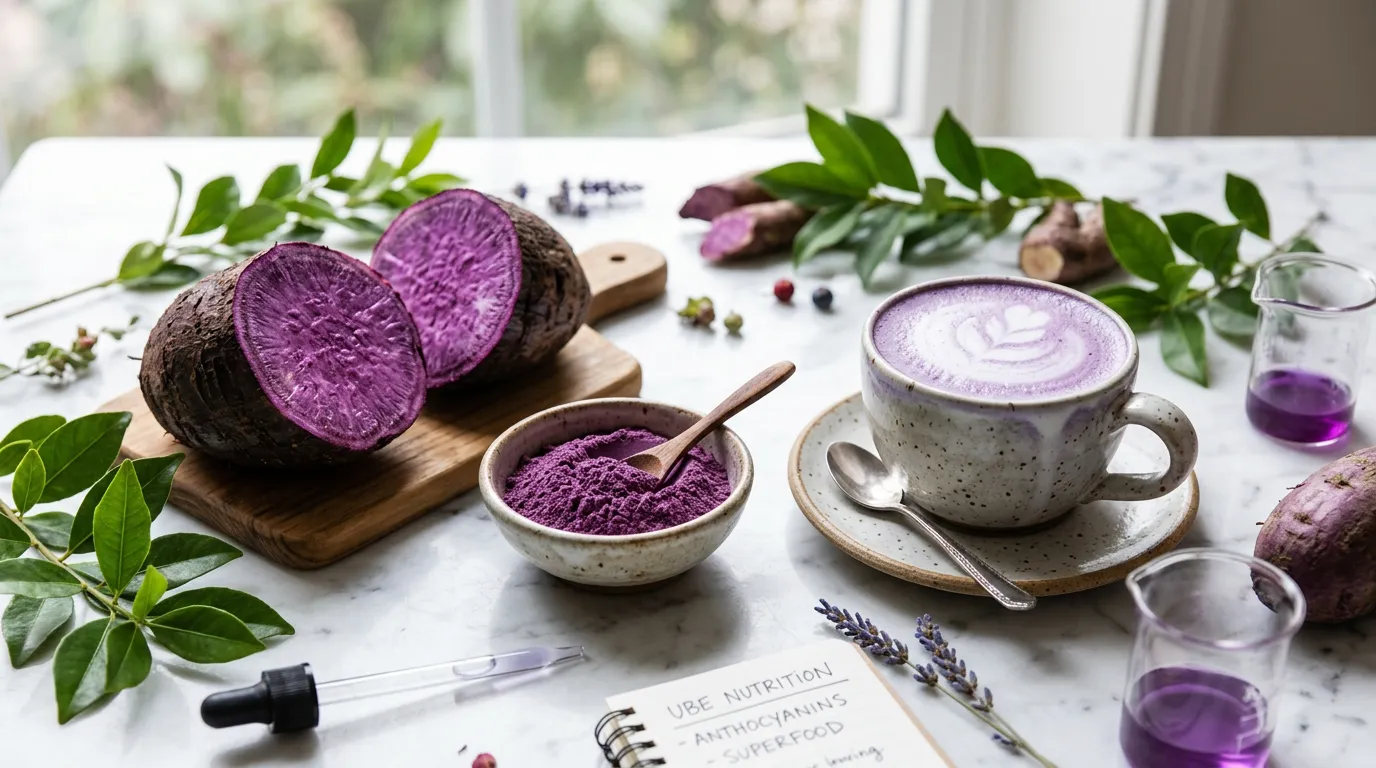
The wellness food space has a complicated relationship with trends. Ingredients cycle through the spotlight with predictable regularity, accompanied by claims that frequently outrun the evidence, only to fade as the next superfood arrives. Against this backdrop, the emergence of ube, the Philippine purple yam, as a genuine object of nutritional interest rather than merely a visually spectacular ingredient deserves attention precisely because the scientific case for its health relevance is more substantive than most superfood narratives allow.
Ube, Dioscorea alata, is a yam species that has been cultivated and consumed in the Philippines for thousands of years. Its extraordinary deep violet-purple colour, produced by acylated anthocyanins that are among the most concentrated and stable found in any food plant, has driven its global social media popularity. But behind the colour is a nutritional profile that includes prebiotic fibres, resistant starch and a phytochemical composition whose biological activity has attracted genuine scientific interest.
For those who want to explore ube in its most accessible form, the warm beverages and ube preparations available at https://ube-latte-shop.com/ offer a practical starting point for incorporating this ingredient into a daily wellness routine, with delivery across Europe and the UK.
The anthocyanin content of ube and why it matters
The deep purple colour of ube is not a mere aesthetic feature but a direct indicator of its anthocyanin content, and anthocyanins are among the most extensively studied phytochemicals in nutritional science. These water-soluble flavonoid pigments, responsible for the blues, purples and reds of plant foods across the spectrum from blueberries to red cabbage, have documented biological activity across multiple health domains that makes them genuinely significant dietary constituents rather than incidental colourants.
What distinguishes ube from most other anthocyanin sources is the structural form of its anthocyanins. The Philippine purple yam contains predominantly acylated anthocyanins, a chemically modified variant that is significantly more stable during food processing, storage and gastrointestinal transit than the non-acylated anthocyanins found in berries and most other commonly consumed purple foods. This stability is nutritionally important because it means a greater proportion of the anthocyanins in ube survive the journey through the upper gastrointestinal tract to reach the colon, where their most significant health effects occur through interaction with the gut microbiota.
Research on ube anthocyanins specifically, as distinct from anthocyanins from berries or other sources, is relatively limited but growing. Studies on purple yam extracts have demonstrated potent antioxidant capacity, inhibition of inflammatory enzymes including COX-2, and modulation of gut bacterial populations in directions associated with improved microbiome health. A study published in Food Chemistry demonstrated that purple yam anthocyanins selectively increased Lactobacillus and Bifidobacterium populations in fermentation models, two bacterial genera consistently associated with gut barrier integrity and reduced systemic inflammation.
Ube as a prebiotic food source
Beyond its anthocyanin content, ube contains a significant concentration of resistant starch, a form of dietary carbohydrate that escapes digestion in the small intestine and arrives intact in the colon where it serves as a fermentable substrate for the gut microbiota. This fermentation produces short-chain fatty acids including butyrate, the primary energy source for colonocytes, the cells lining the colon wall, whose adequate supply is essential for maintaining gut barrier integrity.
The resistant starch content of cooked and cooled ube is particularly notable. Cooking and cooling starchy foods increases their resistant starch content through a process called retrogradation, during which some of the starch molecules rearrange into a more crystalline structure that resists enzymatic digestion. Ube consumed as part of a preparation that involves cooking followed by partial cooling, as in many traditional Filipino ube dishes and in ube powder preparations, delivers meaningful amounts of resistant starch alongside the anthocyanins.
Ube also contains inulin-type fructooligosaccharides, short-chain prebiotic fibres well established in the clinical literature for their ability to selectively stimulate Bifidobacterium growth, reduce gut transit time and improve markers of digestive comfort. The combination of anthocyanins, resistant starch and fructooligosaccharides gives ube a prebiotic profile of unusual complexity and breadth compared to most single food sources.
Ube’s micronutrient composition
Beyond its phytochemical content, ube provides a useful range of essential micronutrients whose contribution to overall nutritional adequacy is worth acknowledging. Potassium is the most abundant mineral in ube, with a 100-gram serving providing approximately 400 to 500 mg, contributing meaningfully to the daily requirement of 4700 mg that most Western diets fail to meet. Adequate potassium intake is consistently associated with lower blood pressure, reduced cardiovascular disease risk and improved muscle function, making ube’s potassium content a genuine nutritional asset.
Vitamin C is present in ube in moderate amounts, with the antioxidant activity it provides complementing the anthocyanin antioxidant content. Dietary fibre beyond the resistant starch fraction contributes to total daily fibre intake, which remains significantly below recommended levels in most Western populations. B vitamins including B6 and folate are present in amounts that contribute to but do not dominate daily requirements.
How to incorporate ube into a nutrition-focused diet
The most nutritionally efficient ways to consume ube are those that preserve its anthocyanin and prebiotic fibre content while minimising the addition of refined sugar that tends to accompany traditional ube preparations in their Philippine culinary context.
Ube powder blended into smoothies, stirred into oatmeal or whisked into warm milk as an ube latte provides the phytochemical benefits with complete control over the sweetener and sweetness level. The warm milk preparation is particularly interesting from a bioavailability perspective because the fat in whole milk or full-fat plant milks may enhance the absorption of the fat-soluble carotenoids that co-occur with the anthocyanins in ube.