
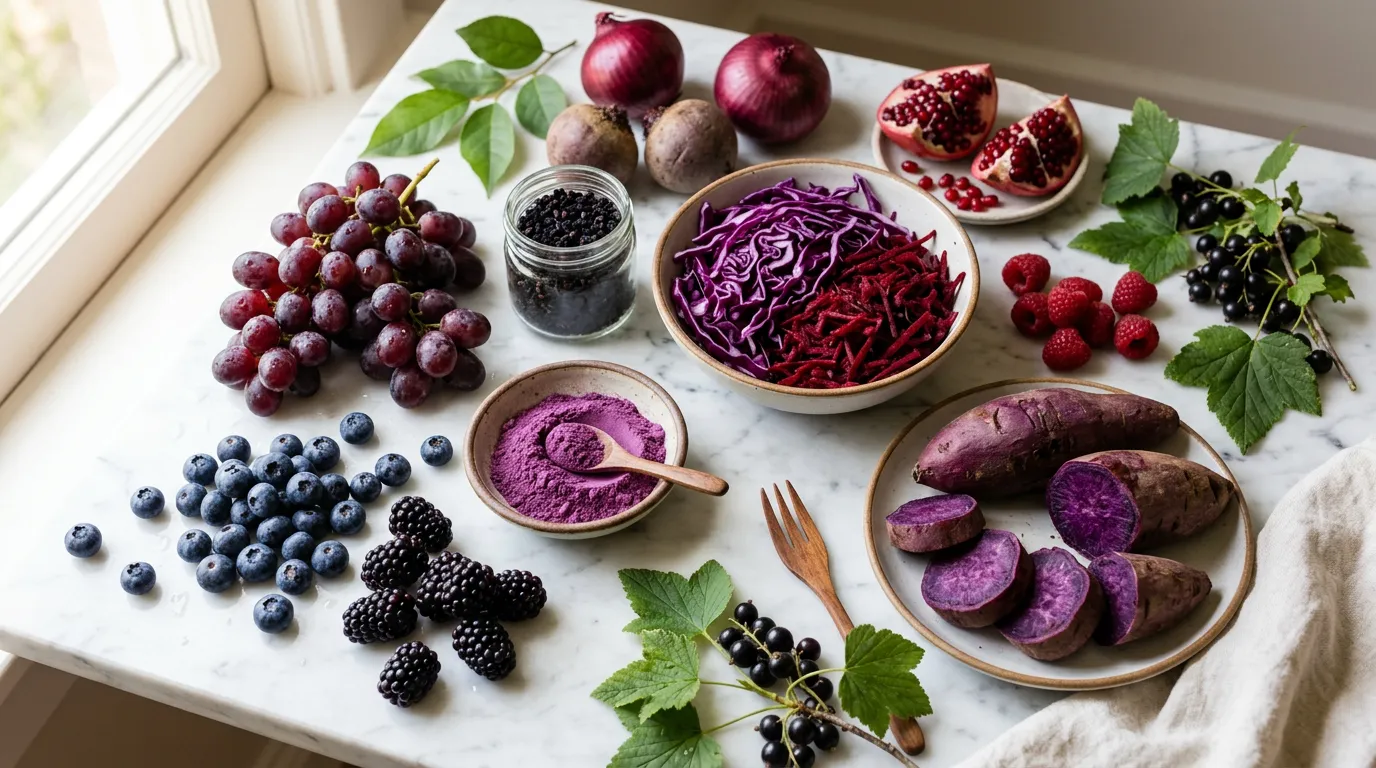
The instruction to eat a rainbow of coloured foods has become so familiar in nutritional communication that it risks being dismissed as a simplification too crude to be actionable. But the underlying science behind this recommendation is considerably more specific and more compelling than the slogan suggests. The colours of plant foods are produced by pigments that are biologically active compounds with documented effects on human health, and the colour of a food is one of the most reliable proxies available for its phytochemical content. Understanding what specific colours signal in nutritional terms transforms a vague encouragement into a practical framework for making food choices that have measurable health implications.
The purple, violet and deep blue colours of plant foods are among the most nutritionally significant in the entire colour spectrum, produced by anthocyanins whose biological activity in the human body has been the subject of thousands of published studies across the past two decades. The accumulating evidence positions anthocyanins as among the most health-relevant compounds in the human diet, with effects on cardiovascular health, metabolic function, gut microbiome composition and systemic inflammation that are increasingly well characterised in clinical research.
Our detailed guide to ube and its health benefits explores one of the most anthocyanin-rich food plants available and what its specific phytochemical profile means for gut health and nutrition.
What produces purple colour in plant foods
The anthocyanins that produce purple, blue and red colours in plant foods are members of the flavonoid family of secondary plant metabolites, compounds produced by plants through metabolic pathways that serve ecological rather than directly nutritional functions. They protect plant tissues from UV radiation, attract pollinators and seed dispersers, and function as antioxidants that protect the plant’s own cellular components from oxidative damage.
The specific shade of colour produced by anthocyanins depends on multiple factors including the pH of the plant tissue, the presence of co-pigments, and the specific chemical modifications of the core anthocyanidin structure. In acidic conditions, anthocyanins appear redder; in more neutral or alkaline conditions, they shift toward purple and blue. This is why red cabbage turns blue-green when cooked in water without acid and why adding a splash of vinegar restores its vivid red-purple colour.
The concentration of anthocyanins varies enormously between plant foods and even between varieties of the same food. Blueberries, blackcurrants, elderberries, açaí, purple cabbage, purple corn and ube are among the richest known sources, while other foods that appear purple or red, including some beet varieties, derive their colour from different pigment classes with different biological properties.
The cardiovascular evidence for anthocyanin-rich foods
The most thoroughly developed area of anthocyanin clinical research concerns cardiovascular health, where epidemiological and intervention evidence converges on consistent associations between higher anthocyanin intake and reduced cardiovascular disease risk.
A landmark prospective study in the Circulation journal following over 93,000 women for eighteen years found that those with the highest intake of anthocyanins from berries had a 32% lower risk of heart attack compared to those with the lowest intake, after adjustment for other dietary and lifestyle factors. This finding has been replicated in multiple subsequent cohort studies across different populations and with different anthocyanin food sources.
The mechanistic evidence supporting these epidemiological associations includes demonstrated effects of anthocyanins on endothelial function, the ability of blood vessel walls to dilate appropriately in response to blood flow, on LDL oxidation rates, and on platelet aggregation and inflammatory signalling pathways. Randomised controlled trials using blueberries, bilberries and mixed berry preparations have documented improvements in flow-mediated dilation, a standard measure of endothelial function, with effect sizes that are clinically meaningful.
Anthocyanins and the gut microbiome connection
The relationship between dietary anthocyanins and the gut microbiome has emerged as one of the most active areas of phytochemical research over the past decade, revealing a two-way interaction whose implications for health extend well beyond the digestive system.
Anthocyanins function as selective prebiotics, providing fermentable substrate that feeds specific bacterial populations while having little effect on others. The selectivity of this prebiotic activity means that anthocyanin intake shapes the composition of the gut microbial community in predictable directions. Consistently across human and animal studies, higher anthocyanin intake is associated with increased abundance of Lactobacillus, Bifidobacterium and Akkermansia muciniphila and decreased abundance of several pro-inflammatory pathobiont species.
Akkermansia muciniphila deserves particular attention in this context. This mucin-degrading bacterium, which lives in the mucus layer lining the gut wall, has emerged as one of the most health-associated species in human gut microbiome research. Its abundance is consistently reduced in individuals with obesity, type 2 diabetes, inflammatory bowel disease and several other chronic conditions, and interventions that increase its abundance are associated with improvements in metabolic and inflammatory markers. Anthocyanins are among the most reliable dietary means of increasing Akkermansia abundance, making regular consumption of purple foods one of the most evidence-supported dietary strategies for supporting this aspect of microbiome health.
The best purple food sources and how to use them
Building a diet that reliably delivers meaningful anthocyanin intake requires understanding which foods provide the highest concentrations and how preparation methods affect their bioavailability.
Blackcurrants and bilberries are the most anthocyanin-dense commonly available foods, with concentrations significantly exceeding those of blueberries despite receiving less nutritional media attention. Their tart flavour makes them less immediately palatable than blueberries for many consumers, but this is easily addressed by incorporating them into smoothies, yogurt or cooked preparations where other flavours provide balance.
Purple cabbage is one of the most cost-effective anthocyanin sources available and one of the most versatile for regular dietary inclusion. Raw purple cabbage in salads and slaws delivers the highest anthocyanin content, but lightly cooked preparations also retain significant amounts. Adding acid in the form of vinegar or lemon juice during cooking preserves the red-purple colour and the anthocyanin stability.
Ube, purple corn and purple sweet potato offer anthocyanin profiles distinct from those of berries and vegetables, with higher concentrations of acylated anthocyanins that are more stable through cooking and digestion. Rotating these starchy purple foods into the diet alongside berry and vegetable anthocyanin sources provides diversity of anthocyanin types that exposes the gut microbiota to a broader range of substrates.