
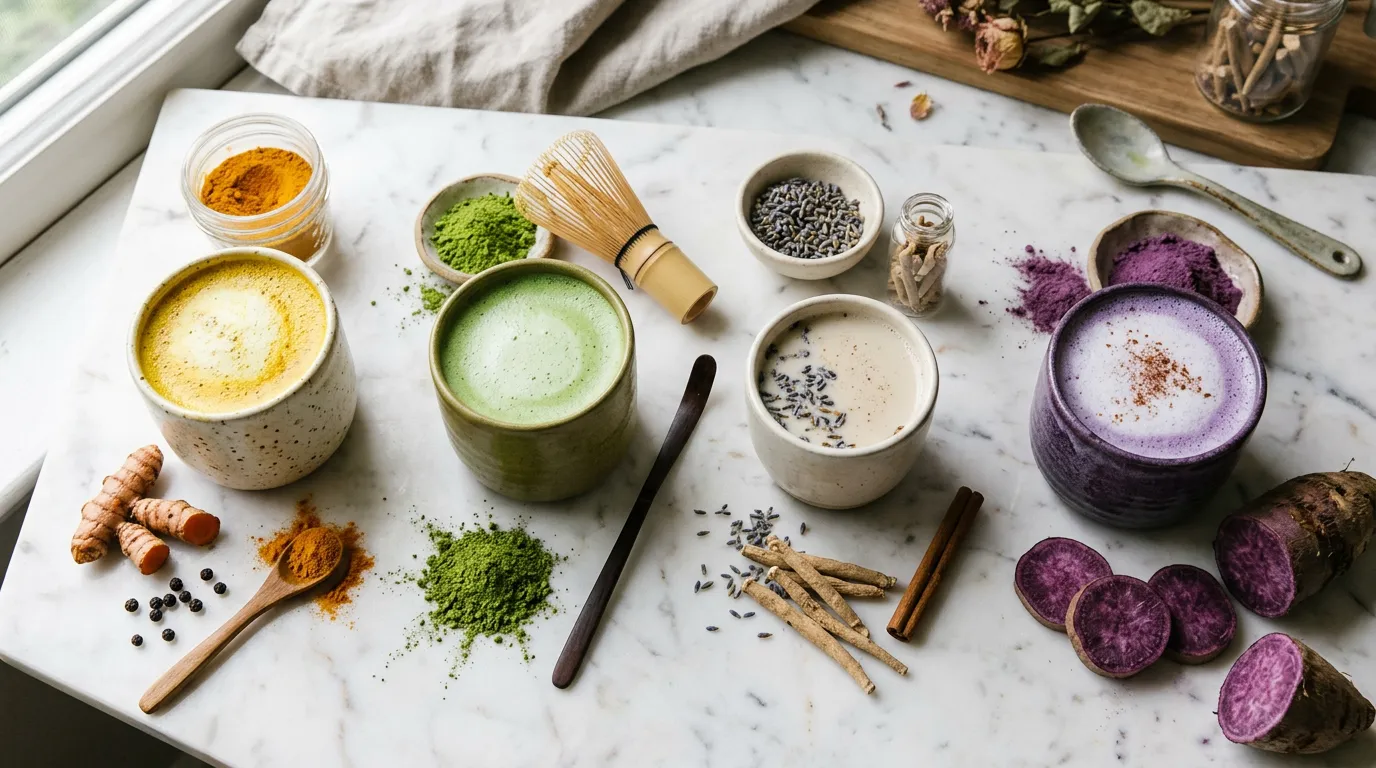
The functional beverage category has grown from a niche wellness enthusiast interest into a mainstream market with global revenues measured in billions of dollars, driven by consumer demand for drinks that deliver health benefits alongside pleasure and hydration. Adaptogenic lattes, warm milk-based beverages containing plant extracts with purported stress-modulating, anti-inflammatory or performance-enhancing properties, are among the fastest-growing subcategories within this space. From ashwagandha moon milk to reishi mushroom coffee to golden turmeric latte to the more recently arrived ube latte, these drinks occupy a space between beverage and supplement that requires careful evaluation to distinguish genuine nutritional value from marketing claims.
The word adaptogen, referring to substances that help the body adapt to stress without disrupting normal physiological function, was coined by Soviet pharmacologist Nikolai Lazarev in 1947 and has been applied with varying degrees of scientific rigour to a range of plant extracts since then. Some of the compounds marketed as adaptogens in functional drinks have robust clinical evidence supporting specific health claims. Others have minimal human evidence despite compelling animal study results or traditional use histories. Understanding the difference is essential for making informed choices about which functional drinks merit inclusion in a nutrition-focused wellness routine.
Our examination of ube’s specific health properties in our guide to ube and its nutritional profile illustrates the level of specificity needed to evaluate any functional ingredient claim: what compounds are present, at what concentrations, and what the human clinical evidence shows for those specific compounds at achievable dietary doses.
Ashwagandha : the adaptogen with the strongest clinical evidence base
Withania somnifera, ashwagandha, is the botanical supplement with the most robust human clinical trial evidence among those commonly incorporated into functional lattes. Its status as a primary rasayana herb in Ayurvedic medicine, where it has been used for over three thousand years as a tonic for vitality, stress resilience and reproductive health, has motivated a level of clinical research investment that has produced a genuinely impressive body of randomised controlled trial evidence.
The primary mechanism through which ashwagandha produces its adaptogenic effects is modulation of the hypothalamic-pituitary-adrenal axis, the central stress response system. Multiple double-blind randomised controlled trials have demonstrated that standardised ashwagandha root extract at doses of 300 to 600 mg daily produces significant reductions in serum cortisol, perceived stress scores and anxiety measures compared to placebo after four to twelve weeks of supplementation.
A 2019 study published in Medicine found that 240 mg of a standardised ashwagandha extract reduced morning cortisol by 23%, reduced stress scores by 44% and reduced anxiety scores by 68% compared to placebo after 60 days in chronically stressed adults. These effect sizes are substantial and clinically meaningful, positioning ashwagandha as one of the few botanical supplements with human evidence strong enough to make specific health claims defensible.
The relevant question for functional latte consumers is whether the ashwagandha content of a commercial moon milk or adaptogenic latte product delivers sufficient active compounds to produce these effects. Clinical studies use standardised extracts at doses of 300 to 600 mg, and the withanolide content that drives the effects varies considerably between ashwagandha products. An ashwagandha latte containing a small amount of non-standardised ashwagandha powder may deliver negligible amounts of the active withanolides that clinical trials used. Checking the ashwagandha content and standardisation of any product before attributing health effects to it is therefore essential.
Turmeric and curcumin : the anti-inflammatory latte ingredient with the most research
Curcumin, the principal bioactive compound in turmeric, is one of the most extensively researched natural compounds in the world with over ten thousand published studies across multiple health domains. The anti-inflammatory mechanisms of curcumin are among the most thoroughly characterised of any natural compound, with documented inhibition of NF-kB, the master inflammatory transcription factor, and COX-2, the enzyme targeted by non-steroidal anti-inflammatory drugs.
Clinical evidence for curcumin’s anti-inflammatory effects in humans is strongest for osteoarthritis, where multiple randomised controlled trials have demonstrated pain reduction and functional improvement comparable to low-dose ibuprofen at doses of 500 to 1000 mg of standardised curcumin extract daily. Evidence for metabolic syndrome, inflammatory bowel conditions and exercise recovery is also accumulating through a growing body of adequately powered human trials.
The critical variable for turmeric latte consumers is bioavailability. Standard curcumin has poor oral bioavailability, with studies estimating absorption at 1% to 10% of ingested dose. Piperine from black pepper, which inhibits the hepatic glucuronidation that rapidly clears curcumin from circulation, increases bioavailability by up to 2000% according to some estimates. A golden milk latte that includes black pepper alongside turmeric is therefore significantly more effective as an anti-inflammatory intervention than one without it. Phospholipid complexes and nanoparticle formulations can further improve bioavailability but are less practically relevant for home preparation.
Matcha : L-theanine, EGCG and the evidence for cognitive and metabolic effects
Matcha green tea, the powdered whole-leaf tea used in Japanese tea ceremony and now ubiquitous in wellness cafés globally, is the functional latte ingredient whose health effects are perhaps most thoroughly grounded in both traditional use and modern clinical research. Its two principal bioactive compounds, L-theanine and epigallocatechin gallate or EGCG, have distinct and well-characterised mechanisms that between them cover cognitive function, metabolic health and gut microbiome composition.
L-theanine is an amino acid found almost exclusively in Camellia sinensis that promotes alpha brain wave activity associated with alert relaxation. Multiple randomised controlled trials have confirmed that L-theanine at doses of 100 to 200 mg reduces psychological and physiological markers of stress and anxiety while maintaining alertness. When combined with caffeine as it is in matcha, L-theanine modulates the stimulant effects of caffeine, smoothing the energy and focus response and reducing the anxiety and cardiovascular side effects that caffeine alone produces in sensitive individuals.
EGCG has extensive evidence for microbiome-modulating effects, consistently increasing Akkermansia muciniphila and Bifidobacterium populations while reducing pro-inflammatory species in patterns that parallel the effects of dietary anthocyanins. As a polyphenol with significant prebiotic properties, EGCG from matcha reaches the colon in concentrations sufficient to alter bacterial community composition, connecting the cognitive and metabolic benefits of matcha to the gut health dimension that is central to the broader functional food conversation.
How to build a functional latte routine that is evidence-based
The most nutritionally rigorous approach to functional lattes is to evaluate each ingredient independently against the available clinical evidence, to understand the dose and form requirements for efficacy, and to rotate between ingredients that provide complementary benefits rather than relying on any single functional drink.
Rotating between a morning matcha latte for cognitive focus and EGCG-driven microbiome support, a golden milk at any time of day for cumulative anti-inflammatory benefit with consistent black pepper inclusion, an evening ashwagandha moon milk for cortisol reduction and sleep quality support, and an ube latte for anthocyanin-driven prebiotic diversity creates a functional latte routine whose combined effects address multiple health domains simultaneously without depending on any single unproven claim.